How Does an Online Quran Teacher Use Visual Aids?
Learning the Quran online has become much more interactive than simply reading from a digital page. Modern teaching methods allow students to see Arabic letters, pronunciation points, Tajweed rules, recitation patterns, and Quranic vocabulary in ways that make lessons easier to understand. 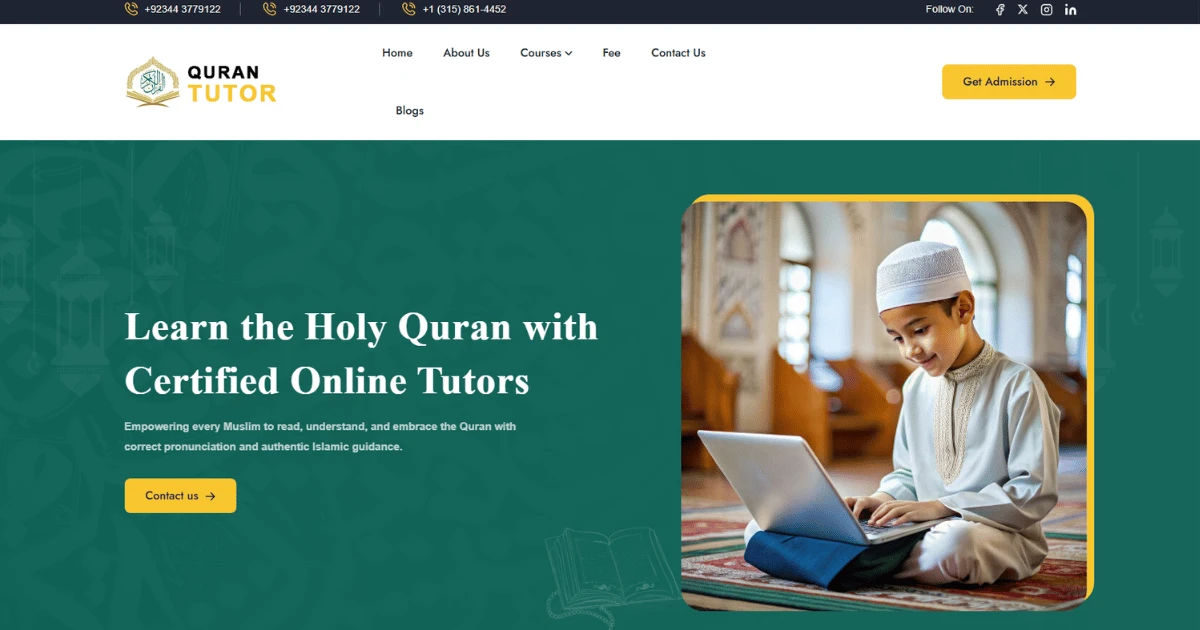 Visual learning can be especially helpful for children, teenagers, and beginners who may struggle with concepts explained only through speech.
An Online Quran Teacher can combine traditional Quran instruction with carefully selected visual materials to make each lesson clearer and more engaging. Instead of asking a student to memorize every rule verbally, the teacher can display examples, highlight letters, demonstrate mouth positions, use color coding, and share diagrams that help the student understand what is happening.
Visual aids are not intended to replace recitation, listening, repetition, or teacher guidance. Their purpose is to support these methods. When visual information is combined with explanation and practice, students can often recognize patterns faster and remember important concepts for longer.
Why Visual Aids Matter in Online Quran Learning
Online Quran classes are different from traditional face-to-face lessons. In a physical classroom, a teacher can point directly to a page, demonstrate something on a board, or use printed materials. Online teachers need digital alternatives that create the same level of interaction.
Visual aids provide that support.
A student may hear a rule several times without fully understanding it. When the same rule is displayed visually, the idea can become much easier to recognize.
For example, Arabic letters that look similar can be displayed side by side. The teacher can highlight their differences and ask the student to identify each one. This creates an active learning experience instead of passive listening.
Visual resources can also help maintain attention. Younger learners may become distracted during a long verbal explanation, while an interactive screen, highlighted Quranic text, or simple diagram gives them something concrete to focus on.
Types of Visual Aids Used in Online Quran Classes
An Online Quran Teacher can use many different visual resources depending on the student's age, level, and learning objectives. The most effective teachers do not use visuals simply because they are available. They choose materials that solve a particular learning problem.
Digital Quran Pages
One of the most common visual aids is a digital copy of the Quran.
The teacher can share the relevant page on the screen while the student recites. Important words, letters, or verses can be highlighted during the lesson.
This allows the teacher to direct the student's attention to a specific part of the text without requiring the student to search through the page independently.
Digital Quran pages can also help students become comfortable navigating the Quran electronically, which is increasingly useful for online learners.
Color-Coded Tajweed Examples
Color coding is particularly useful when teaching Tajweed.
Different colors can represent different pronunciation rules. For example, specific letters or combinations can be highlighted so students can recognize where a particular rule applies.
An Online Quran Teacher may first explain the rule, then show several color-coded examples. The student can read each example while identifying the relevant rule.
Over time, the student begins to recognize these patterns without depending entirely on the teacher.
Arabic Alphabet Charts
Beginners often need strong visual support when learning Arabic letters.
An Arabic alphabet chart can show each letter clearly, sometimes alongside its different written forms. This helps students understand how letters may appear differently depending on their position within a word.
Teachers can also use charts to compare letters that have similar shapes.
For a beginner, seeing the differences between letters such as ب, ت, and ث can be more effective than hearing their names repeatedly.
Pronunciation Diagrams
Quranic pronunciation requires more than simply knowing the appearance of Arabic letters.
Students need to understand where sounds originate and how they are produced. Visual diagrams can show areas of the mouth, tongue, throat, lips, and nasal passage involved in pronunciation.
The teacher can display a simple diagram and explain the relevant articulation point.
This gives students a visual reference while they practice.
Whiteboards and Digital Annotation
Digital whiteboards allow teachers to write or draw during live lessons.
An Online Quran Teacher can use a virtual whiteboard to write an Arabic letter, separate a word into individual letters, mark a vowel sign, or demonstrate how a particular pronunciation is formed.
Annotations can also be erased and recreated quickly.
This makes the online classroom feel more interactive and gives students the impression that the lesson is being created specifically for them rather than delivered from a fixed presentation.
How Visual Aids Support Tajweed Learning
Tajweed can initially appear complicated because students must learn several rules and apply them while reciting.
Visual aids make these rules more manageable by breaking them into smaller pieces.
Highlighting Important Letters
Suppose a student is learning a rule that applies when particular Arabic letters occur together.
Rather than explaining the rule repeatedly, the teacher can highlight those letters in several Quranic examples.
The student then practices identifying them independently.
This develops recognition skills, which are essential for fluent Quran recitation.
Showing Mouth and Tongue Positions
Some pronunciation mistakes happen because students do not know exactly where a sound should be produced.
A diagram can show the approximate position of the tongue or lips. The teacher can then demonstrate the sound verbally while the student watches the visual explanation.
This combination is more powerful than either method alone.
The visual aid gives the student a reference point, while the teacher's recitation provides the actual sound.
Comparing Correct and Incorrect Patterns
A teacher may display two examples and ask the student to identify the difference.
For example, one example may represent the correct application of a Tajweed rule, while another contains a common mistake.
The student can observe the written difference before attempting to recite both examples.
This encourages students to think about their mistakes rather than simply being told that something is wrong.
Visual Aids for Quran Reading Beginners
Beginners have different needs from advanced students.
An Online Quran Teacher working with a beginner may use simple visual aids rather than complicated Tajweed charts.
The first goal is usually familiarity with Arabic letters, sounds, vowel signs, joining patterns, and basic reading.
Letter Recognition
Large Arabic letters can be displayed individually.
The teacher may show one letter, pronounce it, and ask the student to repeat it. The teacher can then introduce another letter with a similar appearance.
This gradual approach prevents students from becoming overwhelmed.
Harakat and Vowel Signs
Arabic vowel signs can be difficult for beginners because they are visually small.
A teacher can enlarge them on screen and use clear examples to show how the pronunciation changes.
For example, students can observe how the same Arabic letter is pronounced differently when different vowel signs are placed above or below it.
Word Building
Visual word-building exercises are another useful technique.
The teacher can display individual letters and gradually combine them into a word.
This shows the student how letters connect and prepares them for reading complete Quranic words.
Using Visual Aids for Children
Children often respond particularly well to visual teaching.
However, visual aids should remain appropriate for Quran learning. They should support the educational purpose rather than turn the lesson into entertainment.
An Online Quran Teacher can use large text, simple diagrams, interactive exercises, and highlighted examples to maintain a child's attention.
For younger students, a teacher might display a letter and ask the child to identify it. The teacher can then show the same letter within a Quranic word.
This creates a connection between basic Arabic learning and actual Quran reading.
Keeping Lessons Simple
Too many colors, animations, pictures, or complicated slides can become distracting.
The best visual materials are usually simple and focused.
A student should immediately understand what they are supposed to look at.
For children, consistency is also important. If the same color always represents the same Tajweed concept, the child can gradually associate that visual signal with the relevant rule.
Visual Aids for Memorization
Memorizing Quran requires repetition, listening, revision, and consistency.
Visual aids can support these activities without replacing recitation.
A teacher may display a short verse and divide it into smaller sections.
The student can memorize one section before moving to the next.
Breaking Verses Into Sections
Long passages can feel intimidating.
Dividing a verse or group of verses into manageable sections gives the learner a clear target.
The teacher can highlight one phrase, ask the student to recite it, and then gradually connect it with the following phrase.
This technique helps students understand the structure of what they are memorizing.
Keyword Recognition
Some students benefit from identifying recurring words or phrases.
A teacher can highlight these words and explain their position within the passage.
When the student later sees the same visual pattern, it may help trigger memory.
This is especially useful during revision sessions.
Using Screen Sharing Effectively
Screen sharing is one of the most practical tools available to an Online Quran Teacher.
The teacher can share a Quran page, lesson document, Tajweed chart, Arabic alphabet, or digital whiteboard.
However, simply sharing a screen does not automatically make a lesson effective.
The teacher should guide the student's attention.
Instead of leaving an entire page visible and saying "read this," the teacher can zoom in on a specific line or highlight the exact word being discussed.
This reduces visual overload and keeps the lesson focused.
Interactive Visual Activities
Visual aids become even more effective when students interact with them.
An Online Quran Teacher can ask learners to identify letters, locate Tajweed rules, match Arabic letters with sounds, or correct highlighted mistakes.
For example, the teacher may display several words and ask the student to find a specific letter.
Another activity could involve showing several Quranic examples and asking which ones contain a particular Tajweed rule.
These activities turn visual learning into active practice.
Visual Aids for Different Learning Levels
Not every student needs the same type of visual support.
A beginner may require alphabet charts and large letter examples.
An intermediate student may benefit more from Tajweed color coding and pronunciation diagrams.
An advanced learner may need detailed annotations related to recitation accuracy, stopping rules, or difficult pronunciation patterns.
A good Online Quran Teacher adjusts visual resources according to the student's progress rather than using the same materials for everyone.
How Teachers Personalize Visual Learning
Personalization is one of the biggest advantages of online education.
If a student repeatedly confuses two letters, the teacher can create a lesson specifically focused on those letters.
If another student struggles with a particular Tajweed rule, the teacher can prepare examples containing that rule.
The teacher can also change the amount of visual support over time.
At the beginning, the student may need heavily highlighted examples. As confidence develops, fewer markings can be used.
Eventually, the student should be able to recognize and apply the rules independently.
Common Mistakes When Using Visual Aids
Visual aids are useful, but they can be ineffective when poorly designed.
One common mistake is using too much information on a single screen.
A crowded slide can make it harder for students to know where to look.
Another problem is relying on visuals without enough verbal explanation and recitation practice.
Quran learning is fundamentally connected to correct reading and pronunciation. Visual resources should support these skills, not replace them.
Teachers should also avoid unnecessary decoration.
The purpose of a visual aid is clarity.
The Role of Visual Aids in Student Engagement
Online learning can sometimes feel less personal than traditional classroom learning.
Visual interaction helps reduce that distance.
When an Online Quran Teacher highlights a student's mistake, writes an example, points to a specific letter, or creates a diagram during a live lesson, the student experiences a more responsive classroom.
This can improve participation.
Students are more likely to ask questions when they can see exactly what the teacher is explaining.
Visual materials can also make progress easier to notice. A student may compare an early lesson with a later one and see how much more confidently they can recognize letters or Tajweed patterns.
Choosing Effective Visual Materials
The quality of a visual aid matters.
Text should be large enough to read comfortably.
Arabic script should be clear and properly displayed.
Colors should be used consistently.
Diagrams should be simple enough for the student's level.
Teachers should also ensure that the material is accurate.
For Quran education, accuracy is particularly important because students are learning sacred text and precise pronunciation.
An Online Quran Teacher should review materials before using them in class rather than relying on random online graphics.
How Parents Can Support Visual Learning
Parents can also encourage students to use visual learning effectively.
They can provide a quiet study space with a suitable screen and stable internet connection.
For younger learners, parents can ask what visual concept was taught during the lesson.
They do not necessarily need to teach the material themselves. Simply encouraging the child to explain what they learned can reinforce understanding.
Parents can also encourage regular revision rather than expecting the child to remember everything from a single lesson.
The Balance Between Traditional and Digital Teaching
Digital tools have changed the way Quran lessons can be delivered, but the fundamentals remain the same.
Students still need accurate recitation, repetition, correction, memorization, understanding, and consistent practice.
Visual aids simply provide another method for delivering those lessons.
The strongest approach combines several learning styles.
A student can look at the Quranic text, listen to the teacher's recitation, repeat the verse aloud, observe a visual explanation, and receive immediate correction.
This multi-sensory approach can make learning more complete.
Benefits of Visual Aids in Online Quran Education
The use of visual aids can provide several practical benefits.
First, they make complicated concepts easier to understand.
Second, they help students identify patterns in Arabic text.
Third, they can improve attention during online lessons.
Fourth, they provide useful references during revision.
Fifth, they allow teachers to personalize explanations.
Finally, visual learning can help students become more independent.
Once students learn how to recognize letters, pronunciation patterns, and Tajweed rules visually, they can begin applying those skills while reading on their own.
Conclusion
Visual aids have become an important part of effective online Quran education because they give students something clear and concrete to observe while they learn. An Online Quran Teacher can use digital Quran pages, Tajweed color coding, Arabic alphabet charts, pronunciation diagrams, whiteboards, annotations, and interactive exercises to make lessons easier to follow.
The key is not to use as many visual tools as possible. The goal is to use the right visual tool at the right time. A beginner may need large Arabic letters and simple examples, while an advanced student may benefit from detailed Tajweed annotations and pronunciation diagrams.
Visual aids are most effective when they work together with listening and speaking. Students should see the text, hear correct recitation, practice themselves, and receive immediate feedback. This combination creates a more complete learning experience than relying on any single method.
A skilled Online Quran Teacher also understands that every learner is different. Some students remember information better when they see it, while others need more repetition or listening practice. By adapting visual materials to individual needs, teachers can make online lessons more accessible, organized, and engaging.
Ultimately, technology should remain a tool rather than the focus of Quran education. The purpose of visual aids is to make correct learning easier, clearer, and more memorable. When used thoughtfully, they can strengthen understanding, support Tajweed practice, improve student participation, and help learners develop greater confidence in reading and reciting the Quran.