
Can Dari children’s books improve vocabulary?
Language development begins with exposure. Children learn new words by hearing them, seeing them, using them, and connecting them with ideas. Books can make this process more engaging because they introduce vocabulary in meaningful stories rather than isolated word lists. For families raising children around more than one language, bilingual book bundles can provide an especially useful way to expose young readers to Dari and another familiar language at the same time.
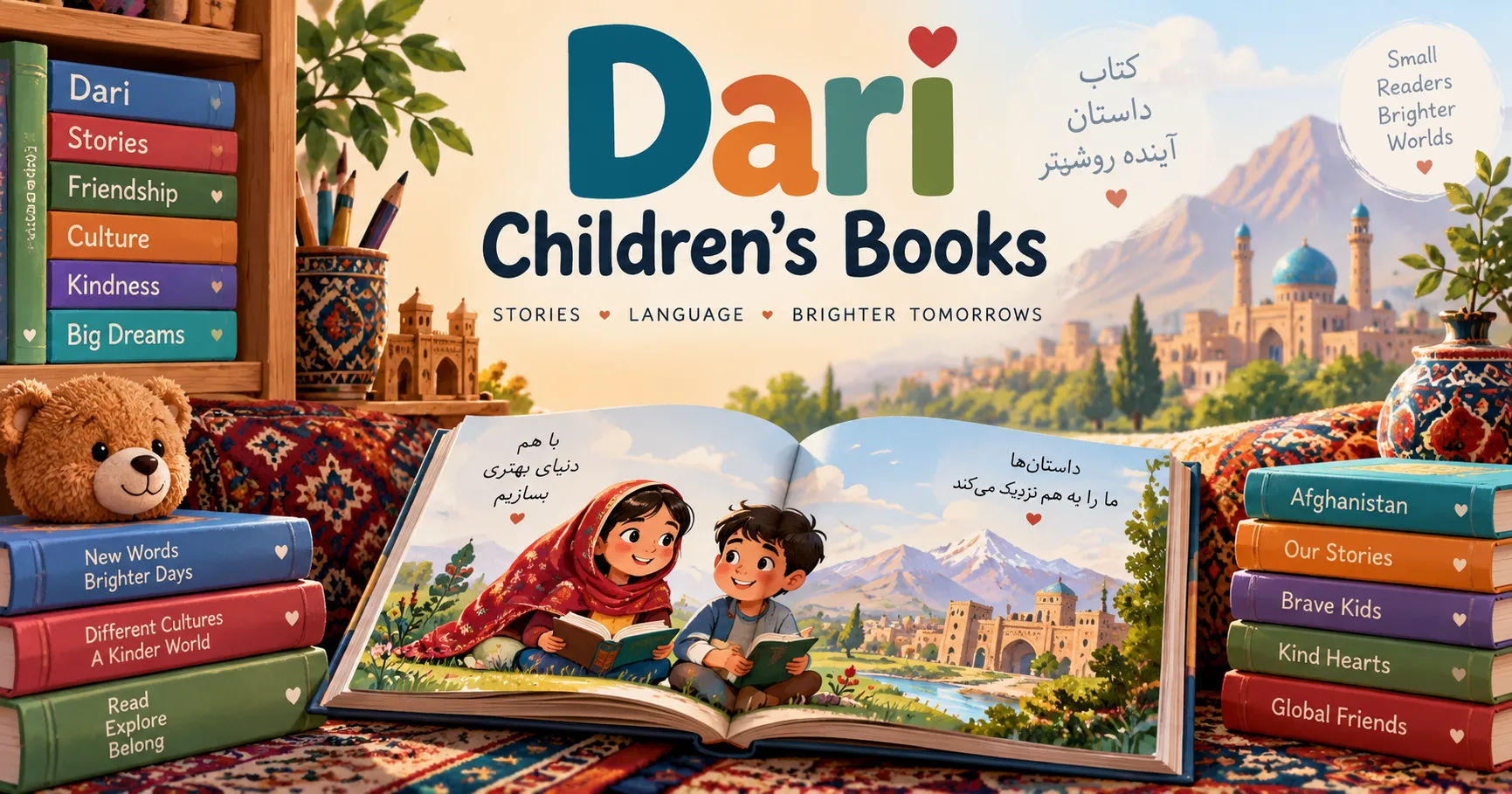
Dari children's books can introduce children to words, expressions, sentence patterns, and cultural references that may not appear regularly in everyday conversations. When children encounter the same vocabulary repeatedly in stories, they have more opportunities to understand and remember it.
But can reading Dari children's books actually improve vocabulary? Yes, regular and interactive reading can support vocabulary growth, especially when adults discuss unfamiliar words and encourage children to use them. The results depend on the child's age, reading ability, exposure to Dari, and how actively the books are used.
Vocabulary Development Through Children's Books
Vocabulary is more than simply knowing the meaning of individual words. A child gradually develops an understanding of how words work in different situations.
For example, a child may recognize a word when hearing it but not use it independently. Another child may understand a word in one situation but struggle to recognize it in a different sentence.
Reading helps because stories show vocabulary in context.
A child can see what a word means through the actions of characters, illustrations, surrounding sentences, and the overall situation. This makes the learning process more natural than memorizing definitions alone.
Repeated Exposure Matters
Children usually need to encounter new words multiple times before those words become familiar.
A single reading may introduce a new word, but repeated readings can strengthen recognition. If the same story is read several times, the child may gradually move from simply hearing a word to understanding it and eventually using it.
This is one reason parents should not assume that children are bored simply because they want to hear the same story again.
Repetition can be a valuable part of vocabulary learning.
Stories Provide Context
Context makes unfamiliar vocabulary easier to understand.
Suppose a Dari story describes a child walking through a garden and seeing a particular type of flower. Even if the child does not know the word for that flower, the picture and surrounding description may provide clues.
The child can connect the new word with a visual image and a specific situation.
This type of contextual learning can make vocabulary easier to remember.
How Dari Books Support Vocabulary Growth
Dari children's books can be particularly useful for children who hear Dari at home but have limited opportunities to read it.
Spoken language and written language are related, but they do not provide exactly the same experience.
Books can introduce vocabulary that may not come up during ordinary family conversations.
Introducing Less Common Words
Everyday conversations often use familiar vocabulary.
Books can expand that range by introducing words connected with nature, emotions, occupations, animals, places, traditions, objects, and imaginative situations.
For instance, a story about visiting a farm may introduce words related to crops, animals, tools, and weather.
A story about emotions may introduce vocabulary describing feelings such as excitement, disappointment, curiosity, fear, or happiness.
Children gradually build a larger vocabulary when they encounter these words in meaningful situations.
Developing Descriptive Language
Children's books often contain descriptive language.
Authors may describe how something looks, sounds, feels, moves, or changes. These descriptions expose children to adjectives, verbs, and expressions that can improve their ability to communicate.
Instead of saying that something is simply "big," a child may eventually learn more specific ways to describe it.
This matters because a larger vocabulary allows children to express their thoughts with greater precision.
The Role of Bilingual Reading
For children growing up with Dari and another language, bilingual reading can create opportunities to compare words and meanings.
A child might encounter an idea in Dari and then recognize the same idea in English or another language. This comparison can strengthen understanding and make vocabulary more memorable.
Connecting Two Languages
When two languages appear together, children can notice similarities and differences between them.
They may learn that one concept can have different words in different languages. They can also discover that sentence structures and expressions may not always translate word for word.
This encourages children to think about language itself.
Dari children's bookscan be useful because they give families multiple reading resources that support this type of language exposure. Depending on the books included, parents can read the same story in two languages or use separate books for different reading sessions.
Supporting Family Reading
Bilingual books can also help family members participate in reading when their strongest languages are different.
A parent who is more comfortable speaking Dari can discuss the story in Dari. Another family member can reinforce the same concepts in English.
The child receives vocabulary exposure from both languages without needing to treat the languages as completely separate parts of life.
Choosing the Right Dari Children's Books
Not every book will have the same vocabulary benefits.
The best choice depends on the child's age, reading level, interests, and current knowledge of Dari.
Consider the Child's Reading Level
Books should be challenging enough to introduce new vocabulary but not so difficult that the child cannot understand the story.
If almost every sentence contains unfamiliar words, the reading experience may become frustrating.
A book with mostly familiar language and a smaller number of new words is often easier to use for vocabulary development.
Look for Strong Illustrations
Illustrations can provide important clues.
A child who does not understand a new word may look at the picture and make a connection between the word and the object or action being shown.
Illustrated books are especially useful for younger children who are still developing reading skills.
Choose Interesting Topics
Children are more likely to pay attention to vocabulary when they care about the story.
A child interested in animals may enjoy books about wildlife. Another child may prefer stories about school, family, adventures, sports, or fantasy.
Interest encourages children to keep reading, and regular reading provides more opportunities for vocabulary growth.
How Parents Can Make Reading More Effective
Simply owning books is not enough.
The way adults interact with children during reading can make a significant difference.
Parents can pause occasionally and ask simple questions about unfamiliar words.
For example, they might ask what a character is doing, why something happened, or what a particular word might mean based on the picture.
Explain New Words Naturally
When a child asks about a word, give a simple explanation that fits the story.
Avoid turning every reading session into a vocabulary lesson.
Instead, explain the word and continue with the story. Later, use the same word in another conversation.
This creates repeated exposure without making reading feel like homework.
Ask Children to Predict Meanings
Parents can encourage children to guess what a word means.
For example, if the story says a character is "shivering" and the illustration shows someone outside in cold weather, the parent can ask what the child thinks "shivering" means.
The child can use clues from the story to form an answer.
This develops both vocabulary and reading comprehension.
Encourage Children to Use New Words
Understanding a word is only one part of vocabulary development.
Children also benefit from using new vocabulary themselves.
After reading, parents can ask children to describe a character or explain what happened using some of the new words.
This can help move vocabulary from passive recognition into active use.
Reading Aloud and Vocabulary Development
Reading aloud is valuable even when children are capable of reading independently.
When adults read aloud, children hear pronunciation, rhythm, sentence patterns, and vocabulary.
This is particularly helpful when the child is learning a language that they do not read frequently.
A parent can read a Dari story aloud while the child follows the illustrations or text. Over time, repeated exposure can increase familiarity with words and expressions.
Discuss the Story After Reading
The conversation does not need to be complicated.
Parents can ask:
What happened first?
Which character did you like?
Why did the character make that decision?
What would you do in the same situation?
These questions encourage children to retrieve vocabulary and explain ideas.
The more opportunities children have to use language, the more meaningful the reading experience becomes.
Can Bilingual Books Confuse Children?
Some parents worry that exposing children to two languages through books might confuse them.
Research and everyday experience with bilingual families show that children can learn multiple languages, although their vocabulary may be distributed differently across languages.
A child might know a particular word in Dari but use a different word in English for the same concept.
This does not necessarily mean the child is confused.
It can simply reflect where and how the child has encountered each language.
Balanced Exposure Is Helpful
Children benefit from regular opportunities to hear and use both languages.
Books can contribute to that exposure, but they work best alongside conversations, storytelling, school activities, songs, and everyday interactions.
The goal should not necessarily be to make vocabulary identical in both languages.
Instead, families can create rich opportunities for children to develop meaningful language skills.
Building a Regular Dari Reading Routine
Consistency is more important than making reading sessions extremely long.
A family might choose a short reading period several times a week.
For younger children, even a brief story can provide useful language exposure.
Older children may be able to read longer stories independently and discuss them with parents afterward.
Keep Reading Enjoyable
Children should associate books with curiosity and enjoyment.
If every story becomes a test, children may lose interest.
Instead of asking for definitions of every unfamiliar word, parents can focus on the story first and naturally highlight a few useful words.
Over time, this approach can create a positive reading habit.
Vocabulary Benefits Beyond Individual Words
The benefits of Dari children's books can extend beyond vocabulary.
Regular reading can support comprehension, listening skills, storytelling ability, background knowledge, and confidence with language.
Children also learn how stories are organized.
They encounter beginnings, problems, events, solutions, descriptions, dialogue, and conclusions.
These structures help children understand and communicate ideas more effectively.
Cultural Vocabulary and Understanding
Dari children's books can also expose children to cultural references, names, traditions, places, foods, and everyday experiences connected with Dari-speaking communities.
Understanding these references can make vocabulary more meaningful.
A word is easier to remember when it is connected to a story, experience, person, or cultural idea.
This is one reason culturally relevant books can have an important place in a child's reading collection.
Using Bilingual Book Bundles at Home
Families can use bilingual book bundles in several practical ways.
Parents may read one story in Dari first and then revisit the same story in another language.
They can also read the bilingual version together and compare selected words.
Another approach is to allow the child to choose the language for each reading session.
The important point is to make both languages part of a positive reading environment.
Create a Personal Vocabulary Collection
When children discover especially interesting words, parents can write them down.
A small notebook can include the new Dari word, its meaning, and a simple sentence.
Children can add drawings or examples.
This turns vocabulary learning into a creative activity rather than a memorization exercise.
Common Mistakes to Avoid
One common mistake is choosing books that are far above the child's reading level.
Another is introducing too many unfamiliar words at once.
Parents may also focus heavily on translation instead of allowing children to understand words through context.
Reading too quickly can also reduce comprehension.
Children need time to look at pictures, ask questions, make predictions, and discuss what they have read.
The goal is meaningful language interaction, not simply finishing a certain number of pages.
Measuring Vocabulary Progress
Vocabulary growth can be gradual.
Parents may notice that a child starts recognizing words without being prompted.
Later, the child may begin using those words during conversations.
Another sign of progress is the ability to explain a story using more specific language.
For example, instead of giving a very short description, a child may begin describing characters, emotions, actions, and events in greater detail.
These everyday changes can show that reading is contributing to language development.
Conclusion
So, can Dari children's books improve vocabulary? They can certainly support vocabulary development when children read regularly and interact with the language in meaningful ways.
Dari books introduce children to words in context, expose them to descriptive language, encourage storytelling, and provide repeated opportunities to hear and recognize unfamiliar vocabulary. When paired with discussion and active use, these experiences can make new words easier to understand and remember.
For multilingual families, bilingual book bundles can add another useful dimension by allowing children to connect concepts across languages. They can support family reading, encourage comparisons between languages, and provide additional opportunities for vocabulary exposure.
The most effective approach is usually simple: choose age-appropriate books, read consistently, discuss unfamiliar words naturally, and encourage children to use the vocabulary they discover.
Books cannot replace everyday conversation or other forms of language exposure, but they can become a powerful part of a child's language-learning environment. With the right stories and an enjoyable reading routine, Dari children's books can help children expand their vocabulary while also developing a stronger connection with reading and language.